
Food Safety in Hot Weather: the Temperature Rules
How summer heat changes food safety: the danger zone, highest-risk foods, and the specific habits that matter at barbecues, picnics, and warm kitchens.
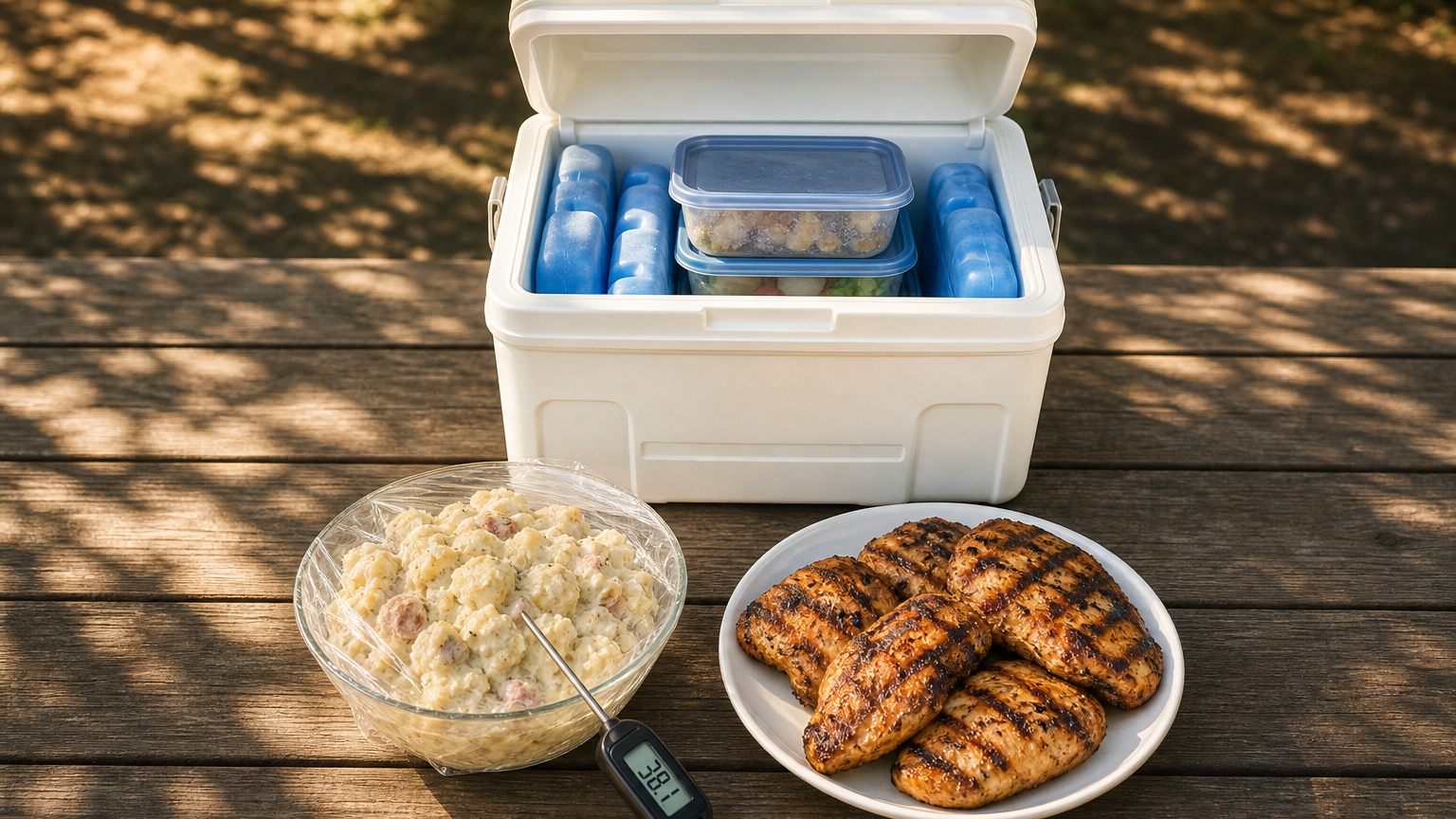
When temperatures rise above 32°C/90°F, food that would have been fine for two hours at room temperature becomes a safety concern in one hour. The bacteria responsible for most common foodborne illness (Salmonella, Campylobacter, Staphylococcus aureus, Clostridium perfringens) don't change in summer. They just multiply faster.
Understanding why temperature affects food safety, which foods are most vulnerable, and what the practical thresholds are makes the difference between a safe summer meal and a miserable few days afterward.
The danger zone
Food safety authorities generally define the "danger zone" as the temperature range between 4°C and 60°C. Bacteria multiply most rapidly in this range, with the fastest growth occurring between 20°C and 40°C. Above 60°C, food is too hot for most food-poisoning bacteria to multiply, though this temperature range does not instantaneously kill all bacteria or destroy preformed toxins. Below 4°C, bacterial growth slows significantly, though some organisms (notably Listeria monocytogenes) can still grow slowly at refrigerator temperatures, which is why refrigeration alone does not make all food indefinitely safe.
The practical implication: food sitting between these temperatures is being colonised at a rate that depends on exactly how warm it is. At room temperature (20-22°C), most food-poisoning bacteria can double in population every 20-30 minutes. At 35°C, that doubling time drops to around 10-15 minutes. By the time food left out in summer heat feels warm rather than cold, it may already have crossed unsafe bacterial counts.
The two-hour / one-hour rule
The US FDA and similar authorities give a rough guideline: perishable food should not be left at room temperature for more than two hours. When the ambient temperature exceeds 32°C/90°F, that window drops to one hour. This is US consumer guidance; other markets use different specific rules, but the underlying principle (hot temperatures accelerate bacterial growth and compress the safe holding window) is consistent.
This rule applies to food sitting out at:
- Barbecues and outdoor dining
- Picnics and beach meals
- Buffets and shared spreads
- Kitchen counters on hot days
Highest-risk foods in summer
Not all foods are equally vulnerable. The highest-risk categories:
Mayonnaise-based salads and dips: potato salad, coleslaw, egg salad, chicken salad, and similar dishes. Mayonnaise itself is acidic and moderately stable, but when mixed with cooked potatoes, pasta, or chicken, the pH rises and bacterial growth accelerates rapidly in warm conditions.
Cooked rice: the spore-forming bacterium Bacillus cereus survives cooking, then germinates and produces toxins in warm cooked rice. Crucially, these toxins are heat-stable and are NOT destroyed by reheating. The prevention is prompt refrigeration: cool cooked rice quickly and refrigerate within two hours. Do not leave cooked rice at room temperature for more than two hours, and reheat only once.
Raw and cooked meat at barbecues: cross-contamination between raw and cooked meat is the main risk. The salmonella food safety post covers this in detail.
Dips and spreads: dairy-based dips (tzatziki, sour cream, cream cheese) and hummus need refrigeration. Hummus is not a dairy product but is still perishable: the chickpeas, tahini, and garlic can harbour bacteria once prepared, and hummus left in summer heat spoils quickly. Brie, camembert, and cream cheese left in sun can develop surface bacteria quickly.
Cut fruit and fruit salads: the cut surfaces of melon, berries, and stone fruit provide an accessible substrate for bacteria, particularly Salmonella (documented in melon outbreaks) and Listeria.
Keeping food cold at outdoor events
Practical ways to maintain safe temperatures at barbecues and picnics:
- Two cold sources: use a cooler bag with pre-chilled ice packs inside. A single thin bag with ice melting from one side doesn't keep food consistently cold enough. Use at least two gel packs, positioned top and bottom.
- Keep the lid closed: every time the cooler opens, cold air escapes and warm air enters. Keep cold food in one cooler and drinks in another if possible, since the drink cooler opens constantly.
- Serve in small batches: instead of putting an entire potato salad bowl on the table from the start, keep most of it in the cooler and refill the serving bowl as needed.
- Pre-chill food, not just the cooler: food placed directly from the fridge into a cooler maintains temperature better than food that started at room temperature.
- Use a thermometer: food should be kept below 4°C. A basic food-safe thermometer in the cooler tells you whether the temperature is actually where you think it is.
Reheating and the internal temperature problem
At barbecues, the most common mistake is putting cooked meat back alongside raw meat on the grill. Any cooked surface touching raw meat is re-contaminated. Use separate plates and tongs for raw and cooked food; don't reuse the marinade brush without boiling the marinade first.
For reheating leftovers from summer events, heat food to at least 74°C throughout, not just until it feels warm on the outside.
When to throw food away
If you're not sure whether food has been out too long, the guideline is simple: if in doubt, throw it out. Food that has been in the danger zone for too long may not smell or look different. Smelling or tasting to check is not a reliable safety test; by the time food smells bad, it has often been unsafe for hours.
Symptoms of common bacterial foodborne illness typically begin 6 hours to 6 days after exposure for Salmonella; within hours for Staphylococcus aureus toxin; 2-5 days for Campylobacter; and up to 70 days for Listeria. The range is wide, which makes tracing a specific meal harder.
Planning summer meals that account for food safety and seasonal ingredients? Gourmate builds personalised weekly plans. Find out how the recipe discovery works.