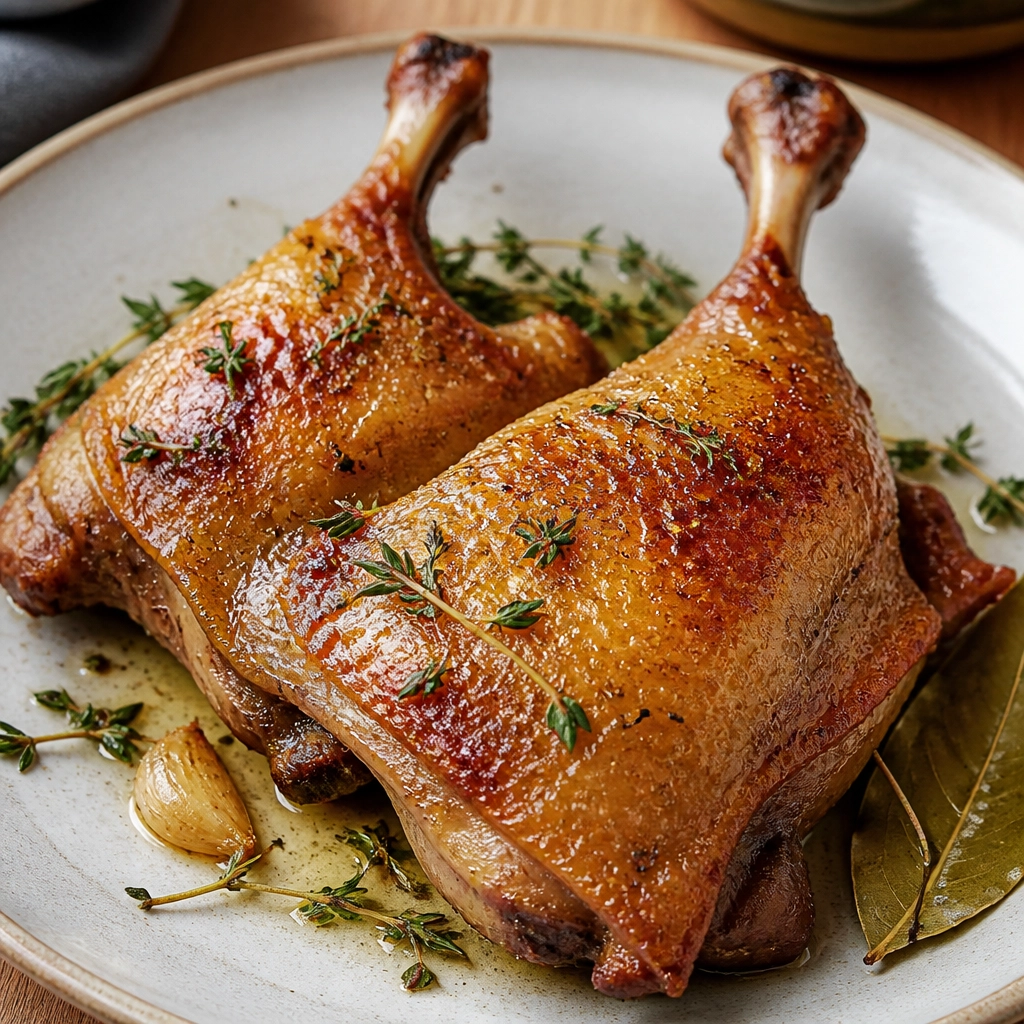
Confit de Canard
Confit de Canard is luxuriously rich, with tender duck meat that yields easily from the bone and deeply savory aromas of garlic, thyme, and bay. Finished in a hot pan, the skin turns crisp and glassy, creating the classic contrast that makes this dish so beloved.
Nutrition · per serving
Ingredients
8 itemsCure and aromatics
Confit cooking fat
To finish
Tips
- •Traditional confit is usually cured for 12 to 24 hours and cooked gently for 2 to 3 hours; this accelerated version is designed to respect the 60-minute limit as closely as realistically possible, but the total time here reflects the true minimum for a good result.
- •Use a very small pot or dish so less duck fat is needed to submerge the legs.
- •The leftover duck fat can be strained, chilled, and reused for roasting potatoes or cooking vegetables.
- •For a paleo-friendly plate, serve with wilted greens, braised cabbage, or roasted turnips.
Steps
- 1
Pat the duck legs very dry with paper towel; dry skin cures more evenly and browns better later. Rub all over with the fine sea salt and freshly ground black pepper, then place in a snug dish with the garlic cloves, fresh thyme, and bay leaves distributed around and over the legs.
2 large (about 700 g total) duck legs12 g fine sea salt2 g freshly ground black pepper4 garlic cloves, lightly crushed6 sprigs fresh thyme2 bay leaves - 2
Cover and cure at cool room temperature for 20 minutes while you preheat the oven to 140°C. This abbreviated cure fits the time limit and still seasons the meat, though it is shorter than the classic overnight method.
- 3
Brush excess surface salt and herbs off the duck legs so the finished confit is not overly salty or speckled with burned aromatics. Arrange the legs skin-side up in a small ovenproof pot or baking dish where they fit closely in a single layer.
2 large (about 700 g total) duck legs4 garlic cloves, lightly crushed6 sprigs fresh thyme2 bay leaves - 4
Melt the duck fat just until liquid and pour it over the duck legs; the legs should be nearly fully submerged. Tuck the garlic, thyme, and bay back into the fat around the meat.
600 g duck fat4 garlic cloves, lightly crushed6 sprigs fresh thyme2 bay leaves2 large (about 700 g total) duck legs - 5
Cook uncovered in the 140°C oven for about 35 minutes, until the meat is just tender when pierced near the drumstick joint and the internal temperature reaches at least 74°C. For classic confit the cook is usually much longer, but with average-sized legs this faster method yields a tender, serviceable version.
2 large (about 700 g total) duck legs600 g duck fat - 6
Carefully lift the duck legs from the fat and let them drain for 3 minutes. Strain off any clinging herbs or garlic so they do not scorch during crisping.
2 large (about 700 g total) duck legs4 garlic cloves, lightly crushed6 sprigs fresh thyme2 bay leaves - 7
Heat 15 g duck fat in a heavy frying pan over medium-high heat. Add the duck legs skin-side down and crisp for 3 to 5 minutes, pressing lightly for full contact, until the skin is deep golden and crackling. Turn briefly for 30 to 60 seconds on the flesh side just to rewarm evenly.
15 g duck fat from the confit pot2 large (about 700 g total) duck legs - 8
Rest the duck legs for 2 minutes before serving so the juices settle and the skin stays crisp. Serve immediately.
2 large (about 700 g total) duck legs
Origin & History
Confit de canard comes from Gascony in southwestern France, where slow-cooking duck in its own fat was originally a preservation method. Over time, it became one of the region’s most celebrated dishes, prized for its rich, silky meat and crisp skin.
Do even more with Gourmate
Cook this recipe in Gourmate — your AI meal planning app.
Plan Meals
Weekly planner at a tap
Ask Questions
Chat with your AI chef
Adjust Recipe
Scale servings & swap ingredients
Cook Mode
Step-by-step guidance
Kitchen Timers
Built-in timers & alerts
Grocery List
Auto-generated shopping lists